Preserving Human Oversight in AI-Enabled Organizations
Most organizations can prove they have an AI policy. Far fewer can prove what actually happened the last time an AI system shaped a real decision.
Which system acted? What controls were live at that moment? Who was positioned to step in? And who, in the end, owns the result? For a striking number of AI deployments, the policy binder is full and the record of the decision is empty. That gap is the problem this paper is about.
As AI moves from advising people to influencing decisions, triggering workflows, and taking actions on its own, the distance between an organization and the outcomes it is answerable for keeps getting longer. The reassuring language of governance — principles, frameworks, training — describes how we intend to behave. It rarely captures what the system did on a particular Tuesday afternoon.
Trustworthy AI cannot be reduced to model behavior. It depends on trustworthy systems of oversight around AI.
From Policy to Proof
There is a quiet but decisive shift happening in how serious organizations think about AI governance. The old question was: Do we have governance? Policies, check. Principles, check. Training, check. The new question is harder, and far more useful:
Can we demonstrate that governance occurred?
It is the difference between owning a fire policy and being able to show that the sprinklers actually worked. A rule that says “high-risk decisions require human review” means nothing if you cannot show, afterward, that a human reviewed a specific decision. Governance that cannot be demonstrated is, for practical purposes, governance that did not happen. This is not a fringe view: emerging standards and regulation — from the NIST AI Risk Management Framework to the EU AI Act — are converging on traceability, oversight, and the ability to reconstruct what a system did.
The pressure is only increasing. As organizations hand AI agents the ability to act — to move money, send communications, change records, trigger downstream systems — the cost of not being able to reconstruct a decision stops being theoretical. The moment an automated action causes harm, the first question everyone asks is the one this paper is built around: can we show what happened, and who was answerable for it?
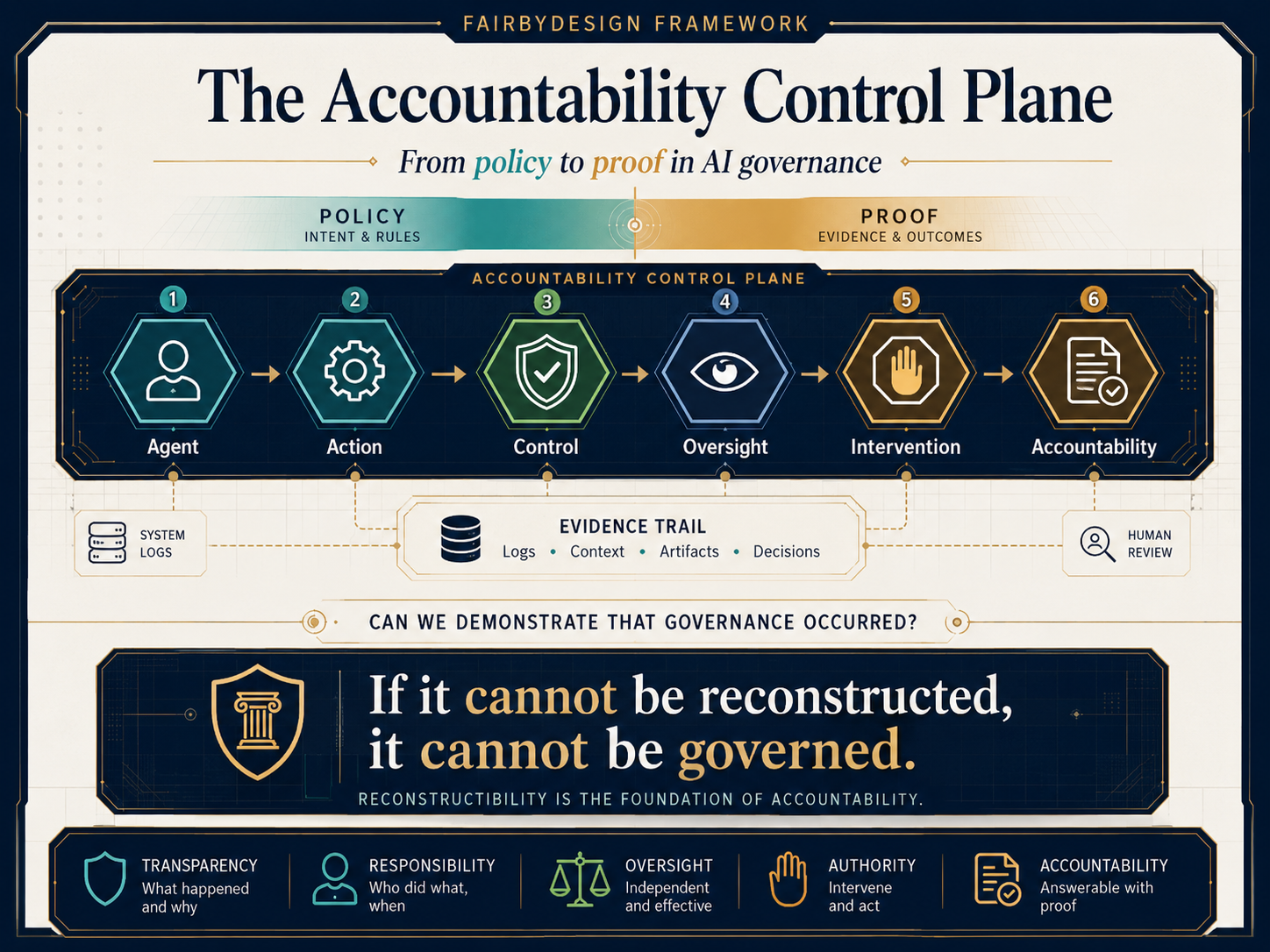
The Accountability Control Plane
To hold an organization accountable for an AI-enabled outcome, you have to be able to follow that outcome back through a chain. We call this chain the Accountability Control Plane:
Agent → Action → Control → Oversight → Intervention → Accountability
Read it as six questions. Which system acted (Agent)? What did it do (Action)? What constraints were in force (Control)? Who was watching (Oversight)? Who could stop it (Intervention)? And who owns the result (Accountability)? When all six links hold, the outcome has an owner and a story. When even one is missing, the outcome is orphaned — produced by the organization, but owned by no one. The power of the model is that it is diagnostic: when something goes wrong, you do not launch a mystery investigation, you find the broken link.
Picture an AI system that declines a customer’s loan application. Months later, a regulator asks what happened. A mature organization can answer every link: it can name the exact model and version that scored the application, show the inputs and the decision it produced, list the credit-policy thresholds and checks that were active that day, identify the team monitoring the model, point to the analyst who had the authority to override it, and name the executive who owns lending decisions made this way. An organization without the control plane can usually answer only the first question and the last — and often not even those. The space in between is exactly where accountability quietly disappears.
If It Cannot Be Reconstructed, It Cannot Be Governed
DOCTRINE If it cannot be reconstructed, it cannot be governed.
This is the line at the center of the paper, and it cuts against a comfortable habit. We tend to treat trust, compliance, and documentation as if they were evidence. They are not. Trust is a relationship, not a record. Compliance describes conformance to a framework, not what happened in a specific case. Documentation describes what we intended to do, not what the system actually did.
Real evidence is the trail that lets someone who was not in the room reconstruct a specific decision after the fact — logs, decision records, proof of the approvals that were supposed to happen, the exact model version in play, where the data came from, and what the system did when conditions fell outside the normal envelope. An organization that pours its effort into policy but cannot reconstruct its own decisions has built a façade. An organization that can reconstruct any consequential outcome holds the raw material of genuine accountability. Evidence is not the paperwork of governance. It is governance, made durable.
None of this requires understanding the inner workings of the model. You do not need to explain why a system produced a particular score to record that it did — under which version, against which data, with whom watching. Reconstruction is about what can be observed, not what must be understood, which is precisely why it stays possible even as the systems themselves grow more opaque.
Why This Matters Beyond Your Organization
This is not only an internal discipline. As AI moves into lending, hiring, healthcare, benefits, and justice, the ability to demonstrate what happened becomes a public matter. When an automated decision harms someone, a regulator, a court, and above all the affected person all need to be able to reconstruct it. An organization that cannot say what its system did leaves the harmed party with no explanation and no route to redress. The deeper question the full paper raises is whether the ability to demonstrate governance should become a precondition for deploying consequential AI — the way auditable accounts are a precondition for running a public company.
A Note on Sources
This paper draws on the NIST AI Risk Management Framework, ISO/IEC 42001, and the logging and human-oversight provisions of the EU AI Act, alongside peer-reviewed research on algorithmic accountability and auditing (Nissenbaum; Matthias; Burrell; Raji and colleagues). Full, linked APA citations and an Evidence Notes source map live in the member Field Paper.
Read the Full Field Paper
Paper I in this series, The Accountability Gap, was published in full because its job was to name a problem everyone can feel. Paper II is operational — it contains the working machinery organizations can pick up and use — so the full Field Paper sits behind Mercury membership. Paper III will turn to the institutions that must oversee autonomous systems across organizations.
The doorway you have just read gives you the shape of the argument: the shift from policy to proof, the central question, the Accountability Control Plane, and the reconstruction doctrine. The full member Field Paper goes considerably further, and includes:
- The complete evidence architecture — what to capture, and why each artifact matters
- How to allocate ownership of every link across engineering, security, product, legal, risk, audit, and executives
- Human oversight design patterns, and how to choose between them by risk level
- Control-effectiveness metrics — and the failure modes that make dashboards lie
- The FairByDesign Accountability Maturity Model, from Experimental to Adaptive
- How to govern systems you will never fully understand
Join Mercury Intelligence
Receive the full Field Paper, its Evidence Notes and references, the Accountability Control-Chain Mapping Table, and the Accountability Control Plane Worksheet — and to map your own AI-enabled decisions onto the six links before something goes wrong.
Leave a Reply
You must be logged in to post a comment.