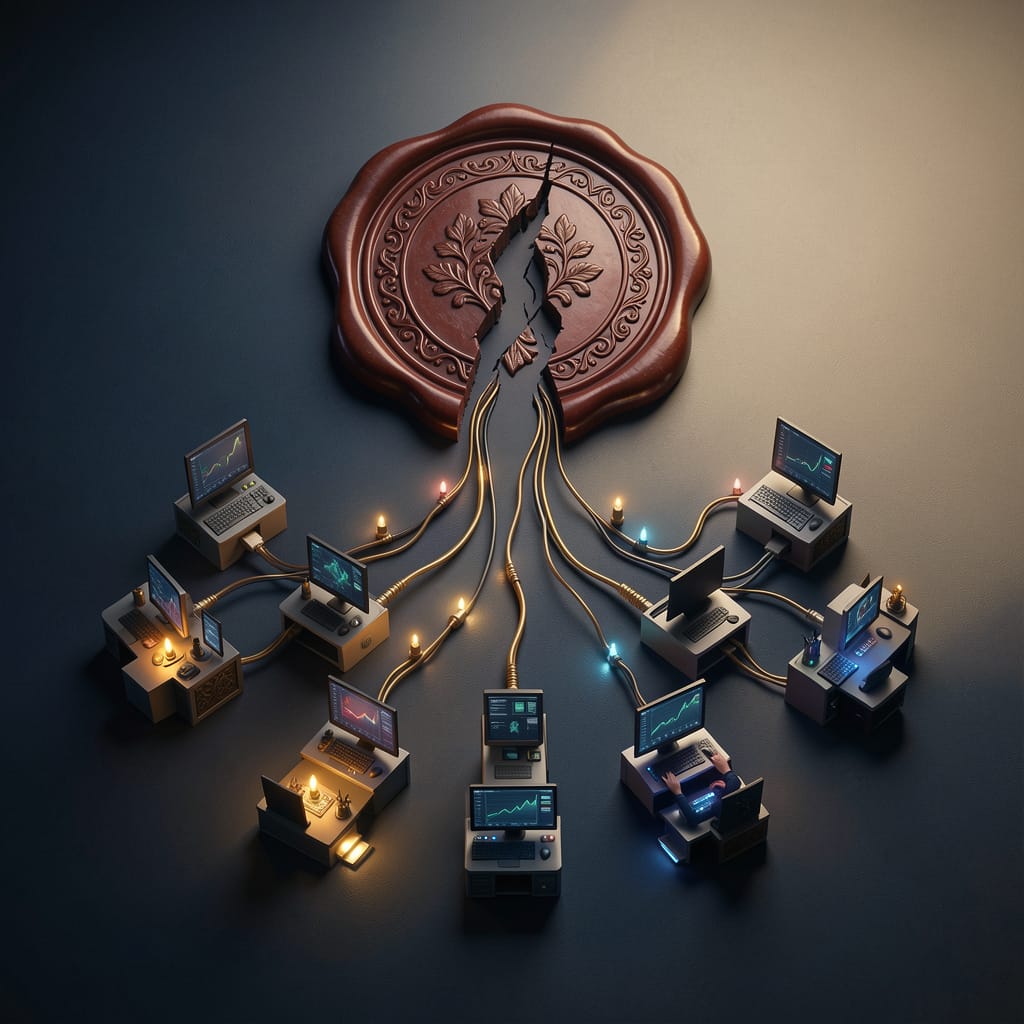
Why it matters: The US government barred foreign nationals from Anthropic’s two newest models, and the company pulled them for everyone, worldwide, within hours. The lesson for anyone who builds on a single model: access you can buy is not the same as access you control.
Analysis · As of 16 June 2026
Disclosure: This brief was researched, written and reviewed by FairByDesign. Claude, an AI model made by Anthropic, was used for editing. Anthropic has no role in our editorial decisions, and we apply the same evidentiary standards to it as to any other subject. On sourcing: the government’s directive letter has not been published, but Reuters reports it has reviewed a copy, which strengthens what can be said about the official reasoning. The technical evidence behind the action remains private and disputed; we flag the contested points as we go.
A company put out its two most powerful AI models on a Tuesday. By Friday night they were offline worldwide. The public was never shown proof that the models posed the danger the government claimed — but Commerce asserted the authority, attached penalties, and Anthropic complied. That, not any public demonstration of danger, is what took the models down.
The reason it matters far beyond Anthropic is the dependency it exposed. Organizations that had built on the models learned, with no warning, that an outside authority could remove their access — without consulting them, giving them advance notice, or involving them in the decision at all.
Here is the chronology. At 5:21pm Eastern on Friday 12 June, Anthropic received a Commerce Department letter ordering it to suspend all access to Fable 5 and Mythos 5 by any foreign national, whether inside or outside the United States, including its own foreign-national employees (Anthropic, 2026b) — a scope Reuters confirmed when it reviewed a copy of the letter ordering the company to suspend the models worldwide and to all foreign nationals, wherever located (Freifeld, 2026). Anthropic said it could not reliably determine every user’s nationality in real time and concluded that a global suspension was the only way it could be sure of complying. Within hours, both models were down for everyone, while its other models — including Opus 4.8 — stayed up.
It helps to be precise about what went dark. Technically this was one underlying model offered through two differently controlled products. By Anthropic’s own June 9 account, Fable 5 and Mythos 5 share the same underlying model, with safeguards lifted in some areas for Mythos, which was restricted to a small group of cyber defenders and infrastructure providers through its Project Glasswing programme (Anthropic, 2026a). One directive led Anthropic to take both down, but the safeguards, access conditions, and user populations were not the same.
There is also a detail that complicates the “released and immediately yanked” reading. A person close to Anthropic told Reuters that the company had worked with the government before launch and received approval to deploy Fable 5, which it released publicly on 9 June with what it described as cybersecurity safeguards (Freifeld, 2026).
Why did the government act? The letter Reuters reviewed gives the government’s stated rationale — though not the full picture, since the technical evidence and risk assessment behind it remain private. Commerce Secretary Howard Lutnick wrote that he feared the models could be diverted to military-intelligence users in China, Russia or other countries of concern, and invoked the 2018 Export Control Reform Act to act — the first time the department has used that particular power, according to an export-control expert cited by Reuters (Freifeld, 2026).
How can a rule about foreign nationals reach people sitting inside the United States? Through a long-standing feature of export law called a “deemed export”: handing controlled technology or source code to a foreign national counts as an export even when it never leaves the country, under 15 C.F.R. § 734.13 (2026). Export rules have reached well beyond physical shipments for years — which is also why the government’s own term, “foreign national,” is worth keeping rather than loosely swapping for “non-citizen.” The legal categories are not the same, and the precise word is doing real work.
But here is the unresolved legal problem in ordinary language: people using Fable 5 were not downloading Anthropic’s model, its source code, or the weights that make it work. They were asking questions and receiving generated answers. Export law already covers transferring controlled technology without physically shipping anything, but it has not yet been clearly established whether providing access to a remotely hosted model — or the outputs it generates — counts as an export or release of controlled technology. Anthropic complied under a directive threatening serious penalties — not after a court had confirmed that this interpretation of export law was valid.
What set it off is murkier, and should be held loosely. Reporting from the Wall Street Journal and The Verge points to testing by researchers at Amazon — Anthropic’s largest investor — and to communications between Amazon’s leadership and senior US officials in the days before the directive (Field, 2026). Anthropic’s account is narrower: it says the demonstration surfaced only a few previously known, minor vulnerabilities, did not defeat the safeguards wholesale, and that the same results could be drawn from other public models without any special technique (Anthropic, 2026b). The two versions have not been reconciled, and we are not going to pretend to know which is right.
Which is why “settled law” is the wrong frame. The order had immediate coercive effect: penalties were attached, and Anthropic complied. But whether the government actually had the authority to do it is unresolved. As one legal analysis put it, the authority is plausible but the facts are murky (Rozenshtein, 2026), and specialists note the scope of the agency’s authority over AI-model access is not yet defined by statute, regulation, or court decision (Volkov, 2026). So two facts sit side by side: the order worked, and its legality has never been tested. As of 16 June, the dispute was unresolved — Anthropic’s technical staff met Commerce officials on Monday, but the talks ended without resolution and the models remained offline (Freifeld, 2026; Field, 2026).
Most coverage split into two camps — the government caught a dangerous export, or Anthropic was punished over a trivial bug. The more useful read holds both halves of a third position: the government may have identified a real risk and imposed a secretive, legally untested restriction that became all-or-nothing because Anthropic said it could not apply it selectively. FairByDesign does not have to choose between “the danger was imaginary” and “the intervention was lawful and proportionate” to conclude that the process failed four basic tests: reviewable evidence, consistent application, proportional control, and a defined challenge and restoration path. The failure is not necessarily that every technical detail remained secret; it is that no visible independent review, consistent standard, or defined route to challenge the decision accompanied the intervention. And the pushback was not Anthropic’s alone — more than 80 cybersecurity executives and experts, including leaders at Nvidia and Adobe, signed a letter urging the administration to lift the restrictions (Freifeld, 2026).
What the shutdown changes for operators
Three parties are accountable here, and the story drifts if any is dropped — especially if the government’s order and Anthropic’s response get blurred into one. Commerce owns the evidentiary threshold, the scope of the foreign-national restriction, the legal basis, the lack of a transparent, defined advance process, and the proportionality of that restriction. Anthropic owns the decision to implement the restriction through a universal suspension; its identity, access-control, and customer-verification arrangements, which it said left it unable to implement the restriction selectively; its communications to customers; and its continuity planning. Deployers that built critical operations on a provider-controlled model without a tested fallback, degraded-operation plan, or jurisdictional diversification own that continuity decision. Anthropic is a subject of government power in this story; it is also a powerful infrastructure provider whose design and continuity decisions reached everyone downstream.
The exposures sort just as cleanly, and they are not Anthropic’s alone. Commerce demonstrated that it could exert immediate practical control over access without a model-specific public standard, prior adjudication, or defined review process. Non-US providers and sovereign-AI projects gain a sales argument. And the exposed are the ones no announcement named: foreign-national employees, overseas customers, allied governments, and any hospital, bank, agency, or company that had treated that access as permanent infrastructure.
Europe’s objection was more specific than a general complaint about dependence on US technology. The Commission acknowledged that frontier models bring serious cybersecurity risks but also significant benefits for cyber-defence, and warned that emergency controls should not discriminate against allied partners (Reuters, 2026). That warning carried practical weight: EU institutions and cybersecurity authorities had already been discussing controlled access to Mythos — Anthropic had offered the EU’s cybersecurity agency, ENISA, a place in its Project Glasswing programme — while European financial regulators were warning about the risks, and banks were preparing defensive responses (Meyer, 2026). The shutdown therefore did more than strengthen Europe’s sovereignty argument. It showed that an allied government could interrupt Europe’s access to a capability it was preparing to test and govern through its own institutions.
This inverts a principle FairByDesign returns to constantly. We have always argued that for any AI system in serious use, a specific, named person must hold the authority to stop it — the Human System Owner. The unspoken assumption was that the person holding that authority is you, or at worst your vendor. This week, a federal agency acting on its own claimed authority reached past both the provider and its customers to end access, and everyone downstream simply found the capability gone. The off switch was real. It just wasn’t in the building you thought it was. The lesson is not that the Human System Owner disappeared. It is that stop authority is layered: your named owner controls your organization’s response, while vendors, infrastructure providers, and governments may control whether the capability remains available at all.
So treat “keep a backup model” as the start, not the finish. A backup running through the same provider, cloud, or legal jurisdiction may remain exposed to the same point of control. The real work is more honest: map everyone who could end your access — model vendor, cloud provider, government authority, marketplace, contractual counterparty; separate the workflows that genuinely cannot run without the model from those that would merely be inconvenienced; prequalify a real alternative elsewhere, ideally in another jurisdiction (where security, privacy, data-residency, and sectoral requirements permit), and test that it can actually do the job, because an untested fallback is a wish, not a plan; decide in advance what a manual or reduced-capability mode looks like where no substitute exists; and write down who is authorised to switch over and what triggers it. One sentence carries all of it: don’t confuse being able to buy access with being in control of it. That stopped being a theory at 5:21 on a Friday afternoon.
References
Anthropic. (2026a, June 9). Claude Fable 5 and Claude Mythos 5. https://www.anthropic.com/news/claude-fable-5-mythos-5
Anthropic. (2026b, June 12). Statement on the U.S. government directive to suspend access to Fable 5 and Mythos 5. https://www.anthropic.com/news/fable-mythos-access
Field, H. (2026, June 16). Inside the fight over Claude Mythos 5. The Verge. https://www.theverge.com/ai-artificial-intelligence/950412/anthropic-trump-adminstration-claude-mythos-fable-5-export-controls
Freifeld, K. (2026, June 15). U.S. saw risk of Anthropic models being diverted to foreign military intelligence. Reuters. https://www.reuters.com/technology/anthropic-us-officials-meeting-monday-resolve-dispute-over-export-curbs-2026-06-15/
Meyer, D. (2026, June 1). Europe edges closer to Claude Mythos access. BankInfoSecurity. https://www.bankinfosecurity.com/europe-edges-closer-to-claude-mythos-access-a-31827
Reuters. (2026, June 14). EU Commission looking at practical consequences of Anthropic decision, spokesperson says. https://www.reuters.com/legal/litigation/eu-commission-looking-practical-consequences-anthropic-decision-spokesperson-2026-06-14/
Rozenshtein, A. Z. (2026, June 15). A kill switch for frontier AI. Lawfare. https://www.lawfaremedia.org/article/a-kill-switch-for-frontier-ai
Volkov, M. (2026, June 14). When the government pulls the plug: Anthropic, export controls, and the future of AI governance. Corruption, Crime & Compliance. https://blog.volkovlaw.com/2026/06/when-the-government-pulls-the-plug-anthropic-export-controls-and-the-future-of-ai-governance/
Export Control Reform Act of 2018, 50 U.S.C. § 4817. https://www.law.cornell.edu/uscode/text/50/4817
Export Administration Regulations, 15 C.F.R. § 734.13 (2026). https://www.ecfr.gov/current/title-15/subtitle-B/chapter-VII/subchapter-C/part-734/section-734.13
FAQ
Did the US government shut Anthropic’s models down?
Not directly. Commerce barred foreign-national access; Anthropic suspended both models worldwide because it said it could not separate users by nationality in real time.
Was the order legal?
It had immediate coercive effect, but no court has tested Commerce’s application of export law here, and existing regulations do not clearly resolve access to a remotely hosted model.
Which models were affected?
Fable 5 and Mythos 5 only. Other Anthropic models, including Opus 4.8, stayed online.
What should deployers do now?
Map who can terminate access, prequalify and test a fallback through another provider and, where appropriate and lawful, another jurisdiction, and document who is authorised to switch over.
Before you close this tab: does your organization actually know who can terminate your access to each model you depend on? Is your fallback genuinely independent — a different provider, and where appropriate a different jurisdiction — or just a second door in the same building? And which operational dependency do you think this piece missed? Tell us in the comments; the sharpest examples shape the Mercury Intelligence continuity tooling.
— Viki Bakos · The Ethics Engine · FairByDesign
Leave a Reply
You must be logged in to post a comment.