-
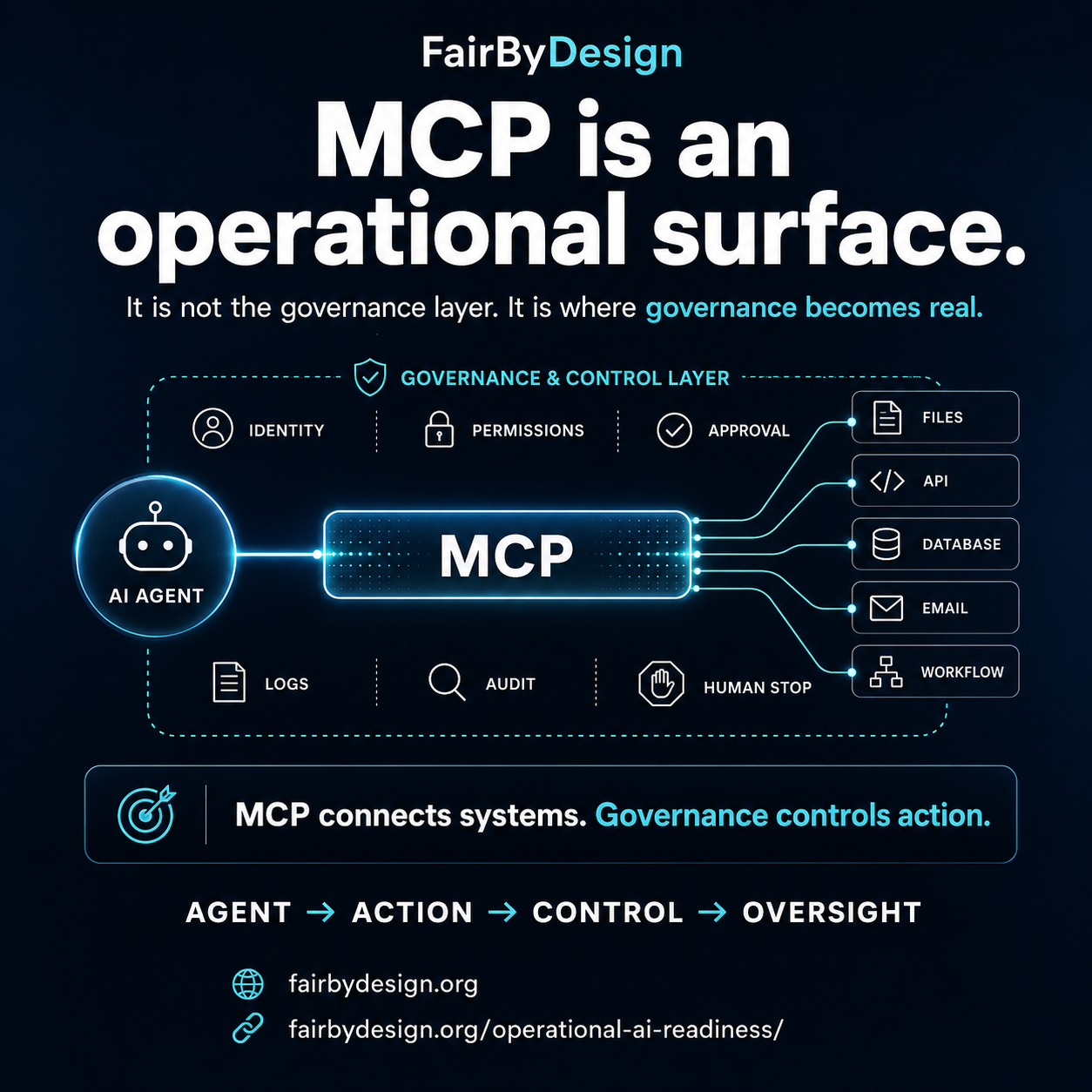
MCP Is an Operational Surface. Governance Has to Catch Up.
FairByDesign — Operational AI Governance Series Field Signal Model Context Protocol, or MCP, is mostly discussed as an integration breakthrough. That is accurate, but incomplete. Anthropic introduced MCP on November 25, 2024 as an open standard for connecting AI applications to the systems where data lives — files, databases, APIs, developer tools, internal systems,…
-

The Accountability Gap — public Field Paper
AI governance is no longer just about accuracy. It’s about whether anyone stays accountable when AI shapes decisions — the accountability gap, and how to close it.
-
The Accountability Gap Field Brief
AI governance is no longer just about accuracy. It’s about whether anyone stays accountable when AI shapes decisions — the accountability gap, and how to close it.
-

The Proof Deficit: Why AI Governance Is Moving From Principles on Paper to Controls in Systems
AI governance is shifting — from principles on paper toward controls running inside live systems. The unresolved problem is no longer a knowledge deficit. The field knows what responsible AI requires. It’s a proof deficit: whether a running system can actively prove who controlled it, when, with what evidence, and whether a human could…
-

Ratified by the EU, Rewritten in Colorado: AI Governance Diverges
In a single week of May 2026, the EU ratified the first binding international AI treaty while Colorado repealed and replaced America’s broadest state AI law with a narrower automated-decision framework. The two moves, a day apart, map a widening but asymmetric transatlantic split.
-
The AI Enforcer Already Open for Business Is Called the GDPR
While much of the AI Act’s use-based high-risk regime is set to move to December 2027, and product-integrated high-risk systems to August 2028, data-protection authorities have kept fining AI-enabled biometrics and profiling under the law already in force and ordering unlawfully collected data deleted.
-

Classify Against the 19 May Draft Guidelines Now — Before They Are Final and Before You Are Rushed
The Commission’s draft high-risk guidelines are the clearest answer yet to “is my system high-risk?” The consultation closes 23 June. Here is how to run the test this week.
-

The Explanation Gap Between GDPR Article 22 and AI Act Article 86
GDPR Articles 13, 14, 15, and 22, together with AI Act Article 86, give affected people different routes to understand and contest automated or AI-assisted decisions — but they cover different decisions, and the gap between them is where a deployer’s real obligation lives. No consequential automated decision in Europe answers to a single…
-

The Clause That Almost Vanished
The public record does not prove who wrote the Digital Omnibus. It shows something more useful: who had access, whose asks aligned with the draft, and which public-visibility safeguard nearly disappeared before the compromise text restored it in narrower form. Read the coverage of the Digital Omnibus and you come away with one fact:…
-

The Regime That Got Nothing: GPAI Enforcement Still Arrives on 2 August
The 7 May Omnibus deal — still a provisional agreement, pending formal adoption — would delay the high-risk rules. It leaves the general-purpose AI obligations exactly where they are. For model builders, the enforcement clock does not move at all.