Here is a question I’d like you to carry around this week. The next time an app, an employer, a school or a government office tells you an AI system is “safe,” “monitored” or “under human oversight,” ask yourself how anyone outside the organization would actually know. Who checked? What did they check? And what would they have needed to be able to say no?
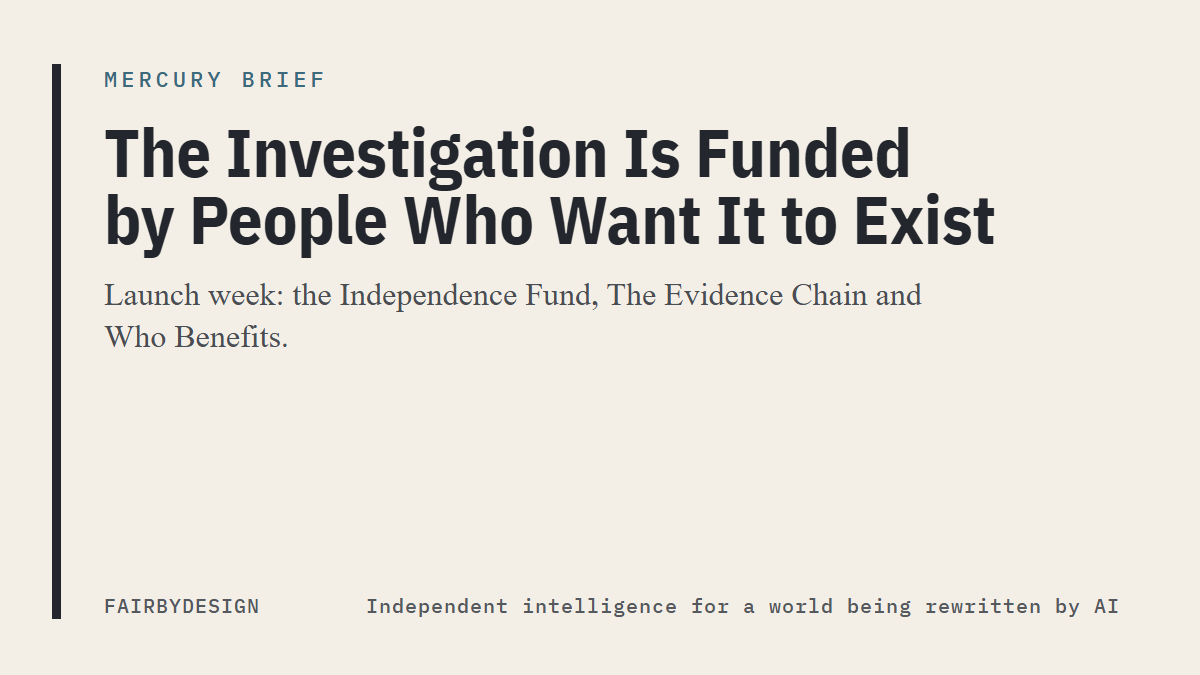
That question is the whole of FairByDesign, and today we are doing two things with it. We are starting a ten-day run of investigation, one installment every day, so that you can follow it as it unfolds. And we are asking the people who want this work to exist, which may include you, to help pay for it, openly, with the machinery on show.
Why we are launching this way
Most AI coverage is built around the headline: a launch, a warning or a lawsuit. We work in what we call the complex middle, the place where a rule becomes a permission, the permission becomes a system, and the system starts making decisions about real people. That is where you find out who actually holds the authority, whether a control does what its documentation says, and whether anyone could reconstruct what happened after something went wrong. Work like that is slow and unglamorous, and it cannot be funded by the companies being examined without turning into marketing. So we are funding it the old-fashioned way, through the people who read it, and we are going to show you every step.
Today’s launch essay, Who Gets to Decide? Why AI Governance Is a Power Question, sets out the argument behind everything that follows. If you are young, it is written with you very much in mind. You do not need anyone’s permission to understand this machinery, and the decisions being taken now will last a lot longer than the people taking them.
What’s coming: ten days of The Evidence Chain
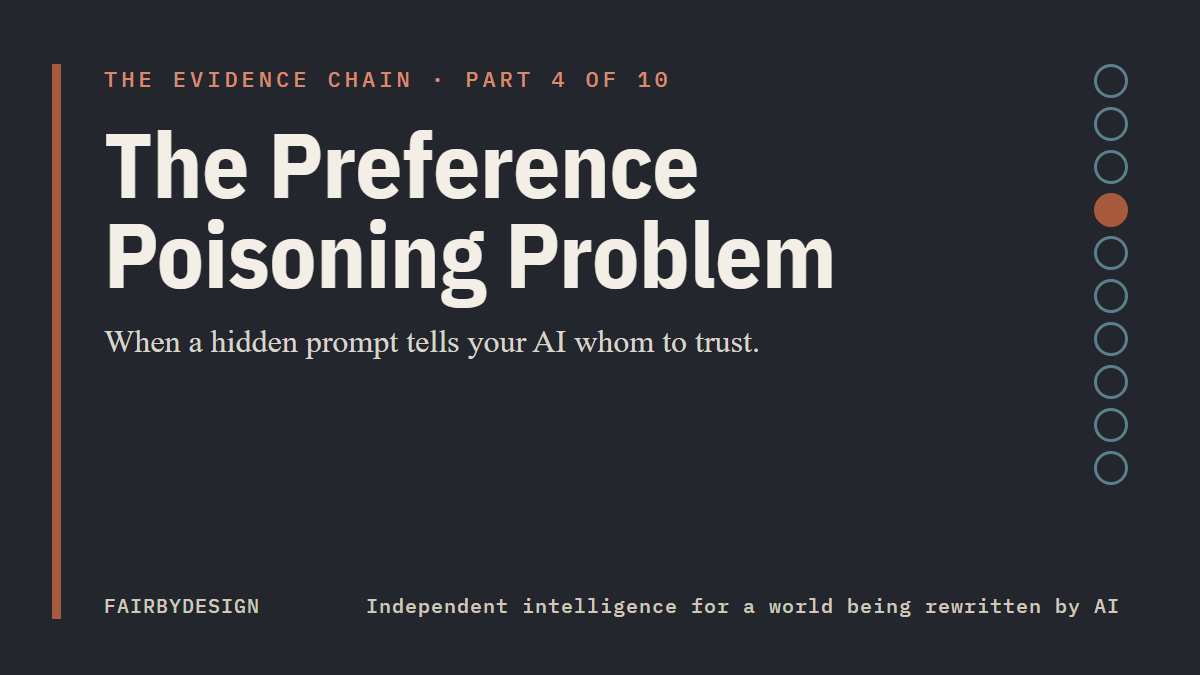
Every day for the next ten days we publish one installment of The Evidence Chain, each one tracing a single gap between what AI governance promises and what the evidence can actually show. Part 1, The Reconstruction Gap, comes out today and asks whether anyone can rebuild what an AI system did after the fact. Tomorrow, The Authorization Gap looks at who actually granted an agent the authority it used. On Monday, The Representation Gap asks whose interests are present when the rules are written. Then, one a day, come The Preference Poisoning Problem, The Common-Mode AI Failure, The Correlated Decision Problem, The Evidence Contamination Problem, Synthetic Consensus and The Evidence Lineage. The series closes on Monday 19 October with The Human Witness. Our first monthly funding update follows on 31 October.
Each installment comes with short clips you can share and an invitation to tell us where we are wrong, and the weekly podcast and video go deeper into the series. Between installments you will also see two other kinds of work. One is demonstrated work, which shows the method rather than just describing it, starting with a look inside Evidence Lab 001, our test of whether an agent control gate actually holds. The other is Deepen the Debate pieces, in which we make the strongest case against our own positions and invite you to reply.
The Who Benefits dialogue
On Wednesdays, every other week starting 14 October, we run the Who Benefits dialogue. The premise is simple and, we think, overdue: the future of AI should not be decided only by the people who profit most from it. The dialogue brings academic, technical, operational, policy and community voices into the same conversation, across regions and cultures and including the Global South, and asks of every proposal the oldest question in accountability reporting: who benefits, and who pays first? The first conversation starts from a single week in September 2026, when a bill to ban superintelligence, two frontier model launches and a United Nations call for global cooperation all landed within days of each other. Later dialogues follow on 28 October, 11 November, 25 November and 9 December.
One more thing for practitioners: Operational AI Readiness, our practitioner field manual, is free in full now.
How you can give
We are launching the 2027 Independence Fund today, and you can read exactly how it works in The 2027 Independence Fund. In short, we show you only the milestone we are working toward and the next one, described by the work it unlocks. We will publish an update on the last day of every month.
The 2027 Independence Fund. Current milestone: $2,500 · Next: $5,000. Just launched. Be one of the first to back it.
Reaching $2,500 keeps the investigation moving, so that the next Evidence Chain installments are researched, sourced and published. Reaching $5,000 runs Lab 001 in public, with the methods published for anyone to check. If you have ever thought “I’m glad someone is doing this,” you can be the someone who keeps it going.
Support never buys editorial control. Supporters do not choose findings, see stories before publication or receive favorable coverage.
How to send us evidence
This part matters as much as the money. If you work with these systems, study them or live on the receiving end of them, you probably know something we don’t. That might be a policy that doesn’t match what the system actually does, a log, an approval process nobody follows, or a research result that complicates one of our arguments. Send general tips, questions and corrections to info@fairbydesign.org, and sensitive material end-to-end encrypted to viktoriabakos@proton.me. Tell us how you would like to be credited, or not credited at all. Where we can, we will answer the best questions on the podcast. The point is not to manufacture consensus. The point is to make the debate harder to fake.
Thank you for reading this far. Forward this to one person who should be asking “who checks?”, and come back tomorrow for the next part.
Give once ($5, $10, $25, $50 or any amount), give monthly ($10 or $25), or become a patron → fairbydesign.org/patrons-2/
Leave a Reply
You must be logged in to post a comment.