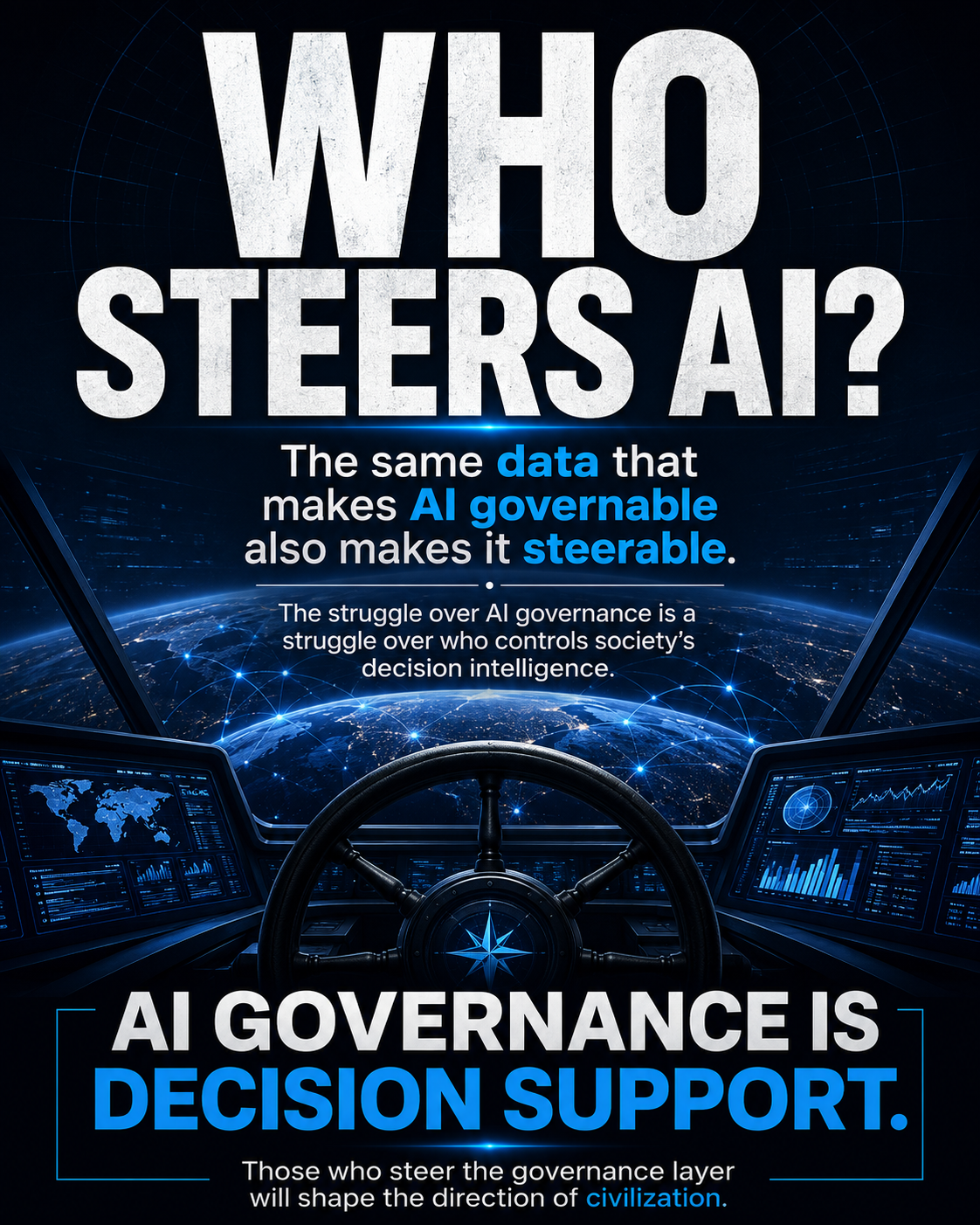
AI governance is often presented as policy, documentation, and compliance. In practice, its deeper function is technical and operational.
When an organization instruments an AI system, captures telemetry, and connects that telemetry to metadata, metrics, business outcomes, and dashboards, it creates decision intelligence. That decision intelligence can reveal what the system did, where it failed, who may have been affected, whether value was created, and when intervention is required.
The same data that makes AI governable can also make it steerable.
That is why control over AI governance matters. Whoever controls telemetry, evaluation criteria, dashboards, and intervention mechanisms can influence what institutions see, what they measure, what they reward, and what they correct. The danger is not necessarily a single billionaire commanding civilization from a hidden control room. The danger is subtler: concentrated private ownership of the infrastructure through which millions of institutional decisions are observed and adjusted.
Open source has redistributed power before.
In 1993, CERN made the World Wide Web software available for free use and modification, helping prevent the early web from becoming the property of a single company. Within a year, the number of known web servers rose dramatically, reflecting rapid adoption after the software was opened. Openness allowed universities, businesses, governments, and individuals to become builders rather than licensed spectators.
The free software and open-source movements extended this principle: people should have the practical freedom to run software, study it, modify it, and share improvements. Open development created communities capable of inspecting systems, correcting defects, adapting technology to local needs, and reducing dependence on one vendor’s permission or commercial survival.
This was not a marginal contribution. Research by Hoffmann, Nagle, and Zhou estimated the demand-side value of widely used open-source software at $8.8 trillion, and found that firms would need to spend about 3.5 times more on software if open-source alternatives did not exist. Open source became part of the economic foundation on which proprietary companies themselves were built.
Historically, openness meant more than free code. It meant that knowledge could escape the boundaries of wealth, ownership, and institutional permission.
The beginnings of an open AI control layer
A similar rebalancing is now beginning around AI.
Andrew Ng’s OpenWorker is an important signal. OpenWorker is an MIT-licensed, local-first AI coworker that can work across files, applications, and connected services while allowing users to choose their own model, including local models through Ollama. It asks for approval before consequential actions and stores conversations, credentials, and agent activity locally rather than requiring dependence on one central AI provider.
Its importance is not simply that another AI agent has been released. OpenWorker demonstrates that the execution layer itself can be inspectable, modifiable, model-independent, and under the user’s control.
Other open-source projects are building the remaining pieces of the steering system.
OpenTelemetry provides shared conventions for capturing traces, metrics, logs, and events. Its generative-AI conventions make it possible to observe model requests, agent activity, and tool use through interoperable telemetry rather than proprietary reporting alone. The project reached graduated status within the Cloud Native Computing Foundation in 2026, reflecting production adoption, multi-organization governance, and an established contributor community.
Langfuse can capture prompts, responses, tool calls, traces, evaluations, experiments, and custom dashboards. Because it can be self-hosted, institutions can retain greater control over the operational evidence generated by their AI systems.
Arize Phoenix provides open-source tracing, evaluation, experimentation, and troubleshooting for AI applications. Its traces can capture model calls, retrieval, tool use, and application logic through OpenTelemetry-compatible instrumentation.
Open Policy Agent adds the actuation layer. It enables organizations to express policy as code, evaluate structured evidence, and return decisions that other systems can enforce. In practical terms, this is how observation can begin to become intervention: allow, deny, restrict, escalate, or require human approval.
Together, these projects point toward an open governance architecture:
Observe → contextualize → evaluate → decide → intervene
That is AI governance as decision support.
Open weights are only the beginning
The word open must still be treated carefully. A company can release model weights while withholding training data, development methods, evaluation process, and surrounding infrastructure.
The Open Source Initiative’s Open Source AI Definition requires more than downloadable parameters. It centers the freedoms to use, study, modify, and share an AI system, along with access to the code and data information necessary to understand how the system was produced.
Ai2’s OLMo project demonstrates what fuller openness can look like. Its releases include model weights, training data, training code, reproducible recipes, evaluation materials, and intermediate artifacts. That gives researchers the capacity to inspect and reproduce parts of the model lifecycle rather than merely execute a finished product.
This is where universities, nonprofit research institutes, professional communities, and public institutions can regain strategic relevance. They do not need to outspend the richest laboratories model for model. They can build independent evaluation capacity, shared telemetry standards, public-interest metrics, local models, reproducible research, and open governance infrastructure.
Openness does not automatically create democracy
Open source creates possibility. It does not guarantee equal power.
AI still requires compute, energy, skilled labor, deployment infrastructure, security, maintenance, and long-term institutional support. A model may be publicly downloadable and still remain practically inaccessible to a small university, public agency, or community organization.
Open-source ecosystems can also be fragile. Hoffmann and coauthors found that a small share of developers generates a very large share of the value in widely used open-source software. Society often depends on a remarkably small group of maintainers whose labor remains underfunded and largely invisible.
Tan and coauthors therefore argue that open-source AI must be supported by public AI infrastructure: institutions and resources capable of providing compute, deployment, maintenance, and oversight in the public interest. Open code without durable public capacity can still leave the richest actors with the practical advantage.
The fear and the opening
The fear is real.
If models, telemetry, metrics, dashboards, and intervention mechanisms remain under the control of a small number of wealthy owners, private systems will increasingly shape what institutions perceive as true, valuable, risky, productive, or worthy of correction.
Those owners would not need to control every decision directly. They would control the architecture through which decisions are seen and steered.
But the outcome is not settled.
OpenWorker, OpenTelemetry, Langfuse, Phoenix, Open Policy Agent, OLMo, and the wider open-source community show that alternative infrastructure is already being built. Universities and research institutions can become more than customers of proprietary intelligence. They can become independent observers, evaluators, builders, and guardians of society’s decision systems.
The wheel is still being constructed.
The real danger is allowing it to disappear behind private dashboards before the public realizes what it controls.
Pay attention. Become aware. Become the watchful eye.
Subscribe to the Mercury Brief.
Leave a Reply
You must be logged in to post a comment.